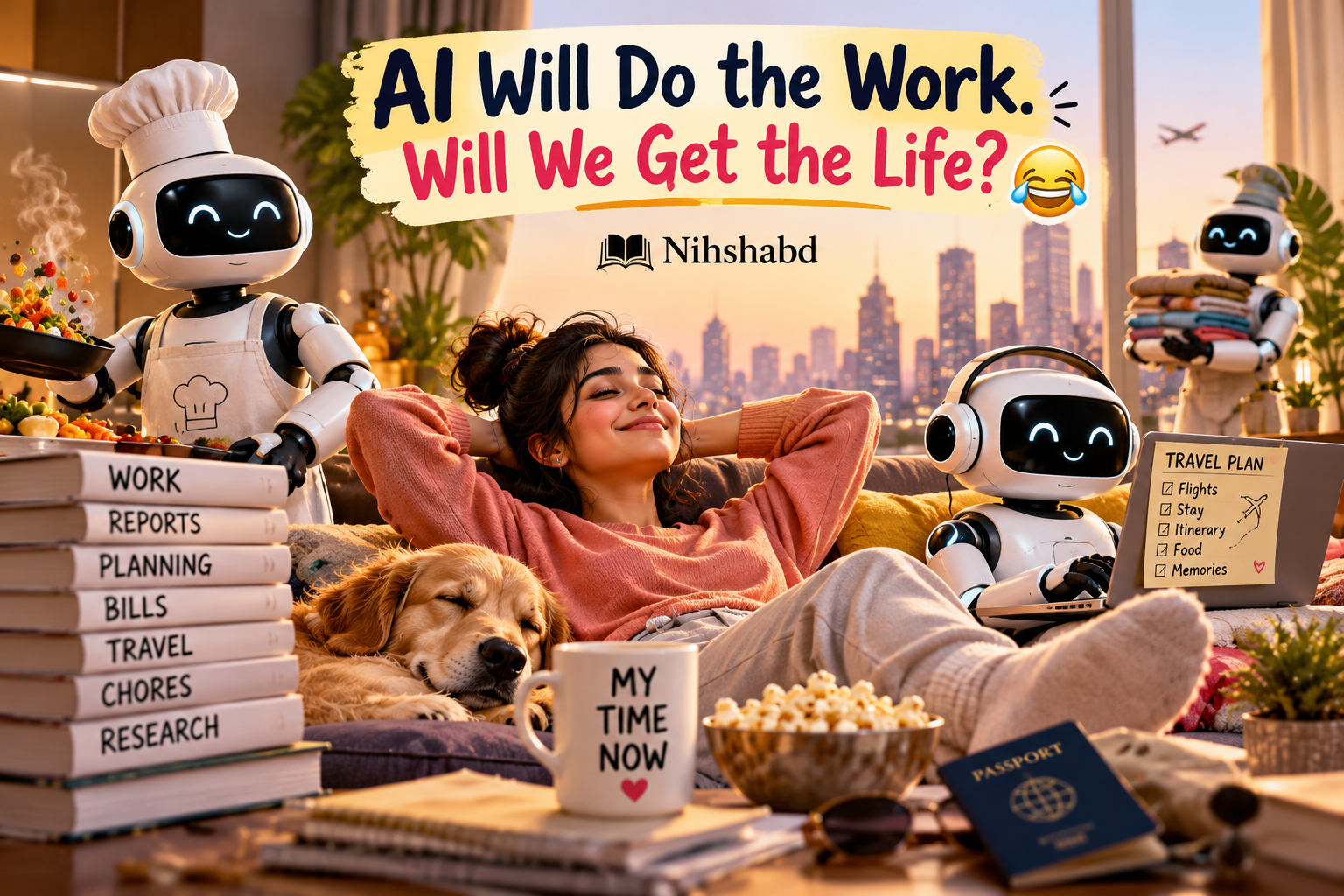


AI Will Do the Work. Will We Get the Life? 😂
What do you think is the future of AI? Will artificial intelligence make our lives easier, transform the way we work, and finally give us more time to enjoy ourselves? Or will we somehow manage to turn this technological miracle into another reason to stay busy?
Knowing humans, I wouldn’t rule out the second possibility. 😂
We invented machines to save time, computers to make work faster, and smartphones to keep us connected. Now we’re developing AI to help us do even more.
At this rate, we’ll soon have technology to finish our work in half the time, followed by twice as much work to fill the time we’ve saved.
Brilliant plan, humanity!
The Future of AI: Your Personal Assistant for Everything
Imagine the future of AI bringing us personal assistants that help organise our work, plan holidays, prepare meals, manage schedules, and handle those repetitive tasks that consume far too much of our day.
Your AI assistant finishes your report, organises your appointments, and helps plan your next holiday.
You lean back and ask, “So, what do I do now?”
“Enjoy your free time,” it replies.
You stare at the screen.
“Sorry, could you explain that? I haven’t experienced this feature before.”
All jokes aside, AI could help us spend less time on routine work and more time on creativity, relationships, hobbies, and experiences that make life enjoyable.
Personally, I’d love to have more time to write, explore new places, and enjoy a cup of coffee without mentally calculating the seventeen things waiting for me afterwards.
And if AI can help with dinner, even better.
Actually, I’d like AI to go one step further. Don’t just suggest recipes or order groceries. Please cook the food, serve it, and clean the kitchen afterwards. I want the complete package, not a fancy digital recipe book! 😂
I’m perfectly happy to participate in the meal without participating in its preparation. 😂
AI and the Future of Work: More Freedom or More Deadlines?
Here’s where the future of AI gets interesting.
Artificial intelligence can help businesses become more efficient, assist people with complex tasks, and automate certain repetitive jobs. It may also change existing careers and create new opportunities, while some roles face disruption.
But increased productivity doesn’t automatically translate into more free time or better pay.
Imagine finishing an eight-hour task in two hours with the help of AI.
You smile. You stretch. You prepare to enjoy the remaining six hours.
Then your boss appears.
“Excellent! Since you’re so efficient now, here’s some additional work.”
And there goes your freedom, escorted out of the office by a fresh spreadsheet.
The real question is whether we will use AI to help people work better and live better, or simply expect everyone to produce more.
Because if technology makes us faster but leaves us just as exhausted, we might need to revisit the definition of progress.
The Future of AI: Solving Problems That Actually Matter
Beyond our personal assistants and workplace deadlines, AI has the potential to help tackle problems that genuinely affect people’s lives.
It could assist medical professionals with research and earlier disease detection, support teachers and students with personalised learning, improve disaster forecasting, and help develop safer, more efficient technologies.
It could also give small businesses access to tools that were once difficult or expensive to obtain.
Imagine a student in a remote village accessing better learning resources, or a small business owner using AI to reach customers and compete more effectively.
That’s the kind of technological progress worth getting excited about.
Of course, these possibilities come with responsibilities. We need to protect privacy, address misinformation, manage risks to employment, and ensure that the benefits of AI are not limited to those who can afford the best technology.
A smarter world is wonderful in theory. A world where more people actually benefit from that intelligence would be even better.
Will AI Make Our Lives Easier?
I hope so. But I don’t think technology alone can guarantee that outcome.
The future of AI will depend not just on what machines can do, but also on how people, businesses, and governments choose to use them.
We could use AI to reduce tedious work, improve access to essential services, and create opportunities for people to learn and grow.
Or we could use it to fill every spare minute with another task, another notification, and another productivity target.
Somehow, I suspect the notifications will arrive first. 😂
I’d like to imagine a future where we have better tools, more choices, and greater freedom to decide how we spend our time.
A future where productivity helps us build a better life instead of becoming our entire personality.
And if AI can help make that happen, I’m all for it.
My Vision for the Future of AI
I don’t expect AI to solve every problem or make the world magically perfect.
I simply hope it helps us do more of what matters and less of what drains us.
Let it help doctors, support teachers, improve safety, assist businesses, and make useful knowledge more accessible. Let it take on repetitive tasks where it can do so reliably and safely.
And let us remember that being human involves more than being productive.
We need time to think, create, laugh, connect with people, explore the world, and occasionally spend an entire afternoon doing absolutely nothing.
That last activity deserves more respect than it gets.
My hope for the future of AI is simple: smarter technology, better opportunities, less unnecessary work, and more time to actually live.
Because if machines can help us do the work, surely we can learn to enjoy the life.
Now, if you’ll excuse me, I’m going to have a coffee and let the future take care of itself for five minutes. ☕😂
What do you think the future of AI will look like? Will it give us more freedom, or will we find a way to turn that freedom into another deadline?😂
.
Until The Next Whisper,
—Rajeshwari 🧿💕
© Nihshabd | The Silent Stories That Speak to the Soul. All Rights Reserved.
.
READ MORE :Future of Technology: Or the Future of Us?


