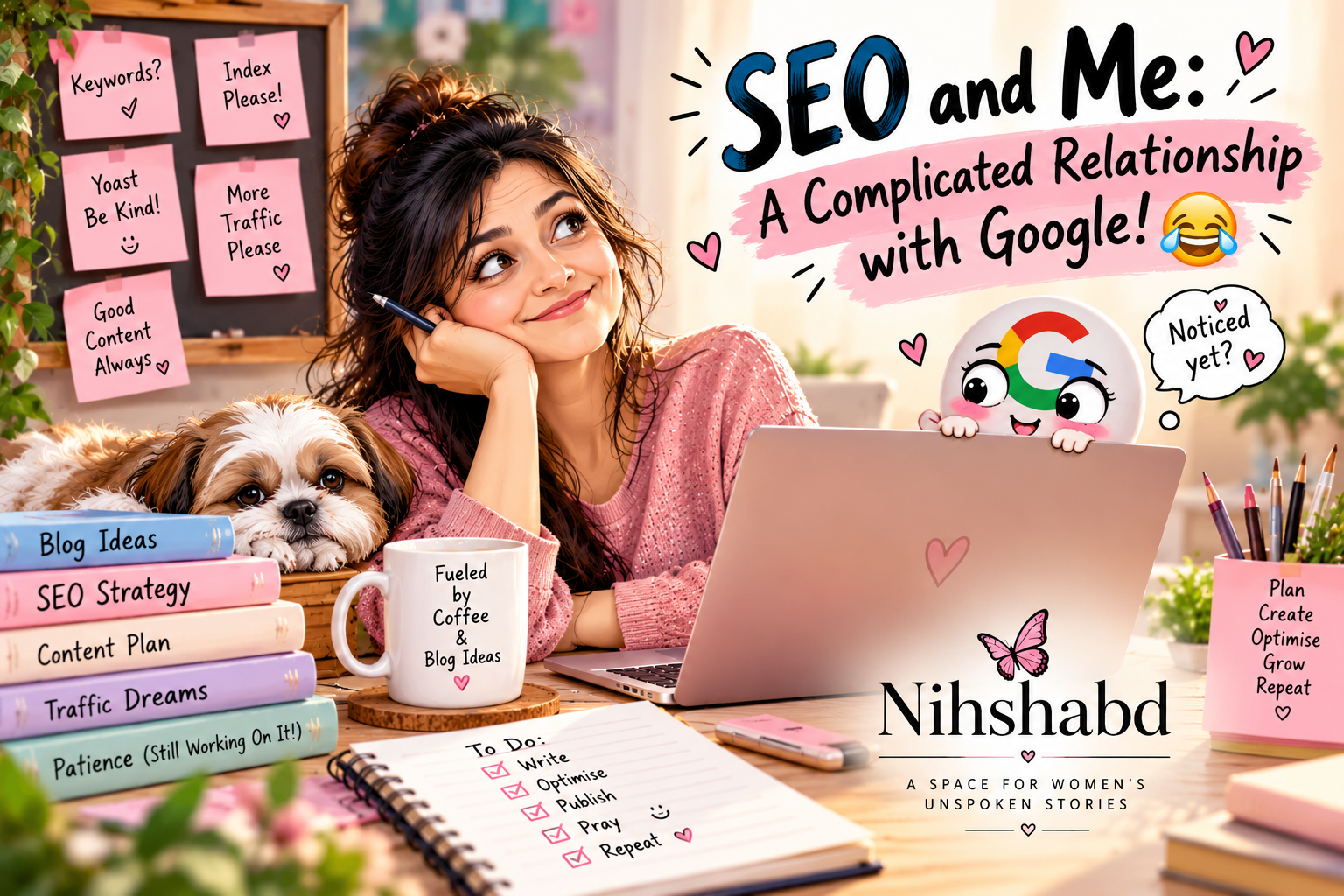
What are your strategies for SEO?
My SEO Strategy: Flirting with Google Without Losing My Self-Respect! 😂
Let’s be honest. SEO is a little like dating.
You write something heartfelt, put your soul into it, dress it up with a beautiful title, and wait for someone to notice. And then… nothing. Absolutely nothing.
Google is giving you the silent treatment, your traffic is playing hide-and-seek, and your carefully written blog post is sitting somewhere on the internet, wondering what it did wrong. 😂
Welcome to blogging!
So, what are my strategies for SEO? Well, I have a few tricks up my sleeve. And no, bribing Google with filter coffee hasn’t worked. Yet. ☕😜
1. Write for humans. Optimise for search engines.
My first rule is simple: write something worth reading.
I want my readers to laugh, think, feel something, or occasionally question their life choices. I don’t want them to feel as if they’re reading a dictionary that swallowed a marketing manual.
Keywords are important, of course. But if I have to squeeze the phrase “best life lessons for women” into every second sentence, my article will sound less like writing and more like a hostage situation.
2. Keywords are guests, not the entire wedding party.
I use relevant keywords in my title, introduction, headings, URL and meta description wherever they fit naturally.
The trick is to help search engines understand what my post is about without making my readers wonder whether I’ve forgotten how ordinary English works.
Keyword stuffing? No, thank you. My blog is not a suitcase I’m trying to close by sitting on it.
3. Yoast SEO is my adviser, not my boss.
Yoast gives me useful suggestions about readability, keyphrases, internal links and meta descriptions. I listen, make improvements, and try to keep those little SEO lights happy.
But if a plugin tells me to rewrite a heartfelt paragraph until it sounds like a washing machine manual, I’m going to exercise my right to disagree.
A green light is lovely. A human voice is lovelier.
4. Internal links: Don’t let your blog posts live like strangers.
I connect related articles, poems and stories on my blog, Nihshabd.
If someone enjoys one post, I’d love for them to discover another. Think of internal linking as introducing your guests to each other at a party instead of letting everyone stand awkwardly near the snacks.
It also helps search engines discover and understand related content on my website.
5. Give every post a little digital housekeeping.
Descriptive titles, meaningful headings, readable URLs, useful meta descriptions, properly sized images with descriptive alt text, and a mobile-friendly website all matter.
I also submit my sitemap through Google Search Console and keep an eye on indexing and search performance.
Because publishing a blog post without checking whether Google can find it is a little like opening a beautiful boutique in the middle of a forest and forgetting to put up a road sign.
6. Pinterest and social media are my wingmen.
I share my posts on Pinterest and Instagram to help them reach readers who might enjoy them.
Social media can bring visitors, introduce new people to my writing, and help my content find an audience beyond my little corner of the internet.
But I remind myself that a thousand impressions are not the same as a thousand loyal readers. I’d rather have people who genuinely connect with my words than numbers that look impressive in a screenshot.
7. Originality is my secret ingredient.
I write about life, women, emotions, everyday absurdities, personal growth, and those little moments that deserve more attention than they usually get.
I want my writing to sound like me.
Because the internet already has enough articles saying the same thing in seventeen different ways. I’d rather add a little honesty, humour and personality to the conversation.
Google’s own guidance emphasises helpful, reliable, people-first content. And honestly, that sounds like a sensible relationship policy.
8. Patience. The most annoying SEO strategy of all.
This is the part nobody wants to hear.
SEO takes time. New content may take time to be discovered, indexed and ranked. Good writing alone cannot guarantee traffic, and a perfectly optimised post doesn’t come with a first-page guarantee.
I check Google Search Console, look at impressions and clicks, investigate indexing issues, and improve my content when needed.
Do I sometimes wonder why Google has discovered a million things but not my carefully written article?
Absolutely.
Do I occasionally stare at my analytics as if the numbers might improve out of sheer embarrassment?
Also absolutely. 😂
But I’m learning that SEO is not just about getting noticed. It’s about helping the right readers find something genuinely worth their time.
My final SEO strategy?
Write with heart. Optimise with common sense. Link thoughtfully. Learn from the data. Keep improving. And never let an SEO plugin convince you that your personality is a technical error.
Because at the end of the day, I don’t just want Google to find my blog.
I want someone to find my words, stay a little longer, smile, think, and perhaps return tomorrow.
And if Google would kindly stop playing hard to get in the meantime, that would be wonderful. 😜
What about you? What’s your SEO strategy? Are you and Google in a healthy relationship, or are you still waiting for it to text you back? 😂
.
Until The Next Whisper,
—Rajeshwari 🧿💕
© Nihshabd | The Silent Stories That Speak to the Soul. All Rights Reserved.
.
READ MORE : Side Hustle Ideas I’d Actually Enjoy Doing 😂
